
Choosing an investment platform is not only about the range of funds, shares or ETFs available. Fees can have a significant impact on long-term returns, especially when investments are held for many years.
Some platforms charge a percentage of your portfolio, others charge a flat annual fee, and some add dealing fees, fund charges or foreign exchange costs. Two platforms that look similarly priced at first glance can end up costing very different amounts depending on how much you invest and how often you trade.
Investors comparing providers can explore UK investment platforms with WiT Money to review different fee structures, account types and platform features.
Why Investment Platform Fees Matter
Investment fees reduce the amount of money that remains invested.
A difference of just 0.25% a year may not sound significant, but over 10, 20 or 30 years it can compound into a meaningful difference.
If two investors achieve the same investment returns but one pays higher ongoing fees, the lower-cost investor keeps more of the growth.
That does not mean the cheapest platform is always the best. Service quality, investment choice, research tools, customer support and account functionality can also matter.
The goal is to understand what you are paying and whether the service justifies the cost.
1. Platform Fees
The platform fee is often the main annual charge.
It may be calculated as a percentage of your portfolio value.
For example:
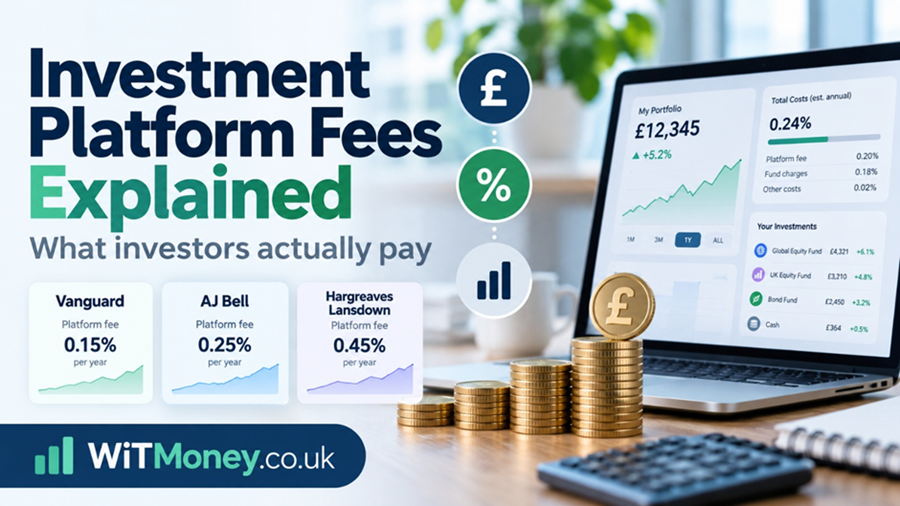
- 0.15% per year
- 0.25% per year
- 0.45% per year
If you have £20,000 invested and the platform charges 0.25%, the annual platform fee would be approximately:
£20,000 × 0.25% = £50
With a £100,000 portfolio, the same percentage would cost around:
£100,000 × 0.25% = £250
This is why percentage-based fees can become more expensive as your portfolio grows.
2. Flat Annual Fees
Some platforms charge a fixed annual or monthly fee instead of a percentage.
For example:
- £60 per year
- £120 per year
- £10 per month
Flat fees can be attractive for larger portfolios because the charge does not rise automatically with the value of your investments.
However, they may be expensive for smaller investors.
A £120 annual fee on a £5,000 portfolio is equivalent to 2.4%.
The same £120 fee on a £100,000 portfolio is only 0.12%.
So the size of your portfolio is one of the most important factors when comparing fee structures.
3. Fund Charges
If you invest in funds, you may pay a separate ongoing charge to the fund manager.
This is often shown as the Ongoing Charges Figure, or OCF.
For example, an index fund might charge:
0.10% to 0.30% a year
while an actively managed fund might charge:
0.50% to 1.00% or more
This fund charge is separate from the platform fee.
So if your platform charges 0.25% and your fund charges 0.20%, your combined annual cost may be around:
0.45% before any other fees
Investors should therefore compare both layers of cost.
4. ETF Charges
Exchange-traded funds also have their own ongoing charges.
These are usually built into the fund rather than charged directly as a separate payment from your account.
A low-cost ETF might charge 0.07% or 0.15% per year.
Specialist ETFs may cost more.
Even when ETF charges appear small, they should still be included when calculating the true cost of investing.
5. Share Dealing Fees
Many investment platforms charge a fee each time you buy or sell shares or ETFs.
Typical charges may include:
- £5 per trade
- £9.95 per trade
- £11.95 per trade
Some platforms offer free dealing.
Others reduce the fee if you trade frequently.
Frequent traders need to pay particular attention to dealing costs.
For example, an investor making 24 trades per year at £10 per trade would pay:
24 × £10 = £240
That can be much more significant than the annual platform fee.
6. Regular Investment Fees
Some platforms offer discounted dealing for monthly investment plans.
For example, a standard share trade may cost £9.95, while a monthly investment order may cost £1.50.
This can make regular investing much cheaper than manual trading.
Investors who contribute every month should check whether the platform offers reduced-cost regular investing.
7. Foreign Exchange Fees
Buying international shares may involve currency conversion.
If you buy a US share using pounds, your platform may charge a foreign exchange fee.
This could be:
- 0.25%
- 0.50%
- 1.00%
- 1.50%
A 1% FX fee on a £10,000 purchase would cost:
£100
If you regularly buy overseas shares, FX fees can become a major expense.
Some platforms reduce FX fees for larger transactions.
Others allow investors to hold foreign currency balances, which can reduce repeated conversion costs.
8. ISA Fees
Some investment platforms charge extra for holding investments inside a Stocks and Shares ISA.
Others include ISA access within the standard platform fee.
Potential charges may include:
- annual ISA administration fee
- transfer-out fee
- dealing fees
- platform fee
An ISA can be tax-efficient, but investors should still compare the cost of operating the account.
9. SIPP Fees
Self-Invested Personal Pensions can have additional charges.
These may include:
- annual SIPP administration fee
- platform fee
- dealing fees
- drawdown charges
- pension transfer fees
For investors using SIPPs, the headline platform fee alone may not reflect the full cost.
Pension investors should compare the total annual cost of maintaining the account.
10. Inactivity Fees
Some platforms charge inactivity fees if you do not trade or log in for a certain period.
This is more common with trading-focused platforms than long-term investment platforms.
For buy-and-hold investors, inactivity charges can be an unnecessary cost.
Before opening an account, check whether the provider expects a minimum level of activity.
11. Withdrawal and Transfer Fees
You may also encounter charges for moving money or investments.
Possible fees include:
- cash withdrawal fees
- investment transfer fees
- account closure fees
- stock transfer fees
Some platforms allow free transfers.
Others charge per holding.
This matters if you plan to switch provider later.
12. Dividend Reinvestment Fees
Some platforms charge a small fee to reinvest dividends automatically.
For example, reinvesting a £100 dividend may involve a £1 or £1.50 fee.
That might sound small, but frequent dividend payments across multiple holdings can increase costs.
Investors using dividend reinvestment strategies should check whether automatic reinvestment is free.
13. Bid-Ask Spreads
Not every investment cost appears as a formal fee.
Shares and ETFs have a bid price and an ask price.
The difference between them is called the spread.
If an ETF can be bought for £10.05 but sold for £10.00, the spread is 5p.
For highly traded investments, spreads may be small.
For less liquid investments, they can be wider.
This is an indirect trading cost that investors should consider, especially when buying specialist or thinly traded assets.
14. Fund Transaction Costs
Investment funds may also incur costs when the fund manager buys and sells securities.
These transaction costs are usually separate from the OCF.
They may include:
- brokerage fees
- taxes
- market spreads
These costs can reduce fund performance even if they are not charged directly to the investor.
Fund documents usually provide more detail.
15. Stamp Duty
UK investors buying certain UK shares may also pay Stamp Duty Reserve Tax.
This is typically charged at 0.5% on relevant share purchases.
For example, buying £10,000 worth of qualifying UK shares could result in:
£50 in stamp duty
This is not a platform fee, but it forms part of the total cost of investing.
How Platform Fees Affect Long-Term Returns
Investment fees compound over time because money paid in fees is no longer invested.
Imagine two investors each invest £100,000.
Investor A pays total annual costs of 0.30%.
Investor B pays 1.00%.
The annual difference is 0.70%.
Over many years, the impact can become substantial because Investor A retains more capital to compound.
This is why seemingly small fee differences matter more over long investment horizons.
Percentage Fee vs Flat Fee: Which Is Better?
Neither model is always cheaper.
A percentage fee often suits smaller portfolios.
A flat fee can become more attractive as the portfolio grows.
For example:
Platform A: 0.25% annual fee
Platform B: £120 flat annual fee
On £20,000:
Platform A costs £50.
Platform B costs £120.
Platform A is cheaper.
On £100,000:
Platform A costs £250.
Platform B still costs £120.
Now Platform B is cheaper.
This is why investors should calculate fees based on their own portfolio size.
Do Not Compare Fees in Isolation
Low fees are important, but they are not the only consideration.
Investors may also want to compare:
- investment range
- customer service
- mobile app quality
- research tools
- ISA availability
- SIPP availability
- fractional shares
- fund availability
- international markets
- security features
- transfer process
A slightly more expensive platform may still be worthwhile if it provides features you genuinely use.
What Should Investors Compare?
Before choosing an investment platform, compare:
- annual platform fee
- flat fees
- fund OCFs
- dealing charges
- ETF costs
- FX fees
- ISA charges
- SIPP charges
- dividend reinvestment fees
- withdrawal and transfer fees
- inactivity fees
- market spreads
The most useful number is the total annual cost for your expected investing behaviour.
A Simple Example
Imagine you invest £50,000 in ETFs and make 12 trades per year.
Platform A charges:
- 0.25% platform fee = £125
- £5 per trade = £60
- ETF charges = £75
Total estimated annual cost:
£260
Platform B charges:
- £120 flat fee
- free trading
- ETF charges = £75
Total estimated annual cost:
£195
Platform B appears cheaper for this investor.
But someone with a smaller portfolio and fewer investments may get a different result.
Final Thoughts
Investment platform fees can be more complicated than they first appear.
The headline platform charge is only one part of the cost. Investors may also pay fund fees, dealing charges, foreign exchange costs, pension fees, transfer fees and other expenses.
The cheapest platform depends on your portfolio size, the investments you hold and how often you trade.
Rather than asking:
“Which platform has the lowest fee?”
a better question is:
“Which platform has the lowest total cost for the way I invest?”
Investors researching providers can explore UK investment platforms with WiT Money to compare platform features and fee structures.
Understanding the full cost before opening an account can help investors keep more of their returns invested for the future.