
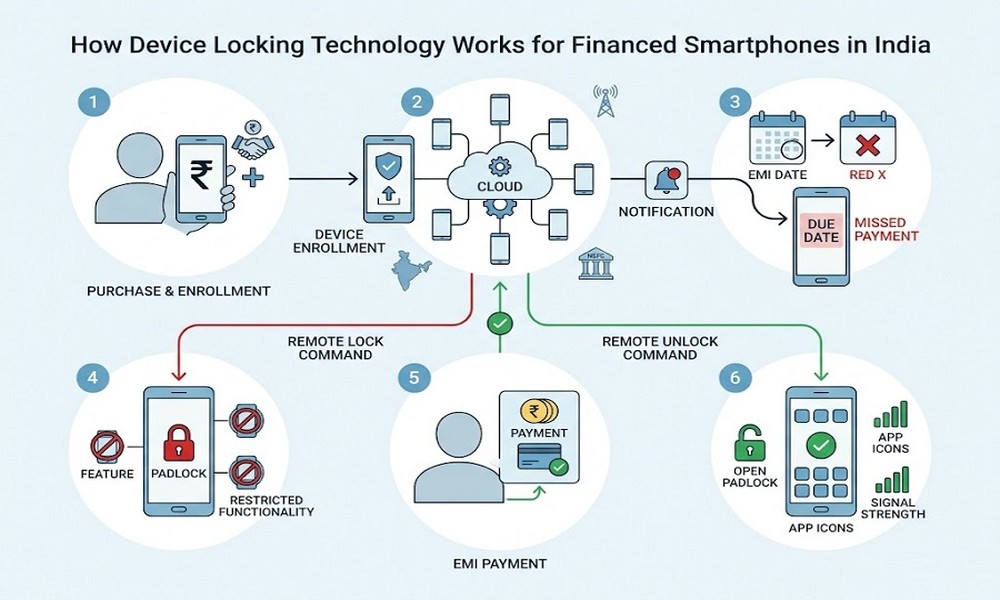
Buying a smartphone on EMI has become a reflex for most Indian consumers. Walk into any Croma, Reliance Digital, or even a local mobile shop in a Tier-2 city, and you will find no-cost EMI schemes on almost every handset. But behind that convenience sits a technology most buyers never think about – until they miss a payment. It is called device locking, and it is quietly reshaping how financed smartphones are managed across India.
What Is Device Locking?
Locking is a software feature that enables a lender or financing company to remotely disable a smartphone’s features when a borrower fails to pay his/her EMI. Consider it as electronic notes. Unlike a two wheeler or appliance, a phone can’t be retrieved simply by showing up at the door of the borrower, so device locking provides lenders with a practical way to ensure the loan is repaid without having to physically go into the borrower’s house.
In India, where millions of customers avail of platforms such as Bajaj Finserv, ZestMoney and operator linked EMI schemes, there is a real risk of default. Device locking directly addresses that risk.
How Does It Actually Work?
The process runs in the background from the moment the phone is activated:
1. Pre-installed Locking Agent Before the phone reaches the buyer, a lightweight software agent is embedded at the system level – often as a non-removable app. This agent cannot be deleted through normal settings.
2. Regular Server Check-ins The agent silently communicates with the lender’s server to confirm whether payments are current. As long as EMIs are on track, the phone functions normally and the user notices nothing.
3. Lock Trigger on Default If a payment is missed beyond the grace period, the server sends a lock command. Depending on the lender’s setup, device locking can range from persistent payment reminders on screen to a near-complete shutdown of the phone’s functions.
4. Instant Unlock on Payment Once the overdue amount is cleared, the server sends an unlock signal and full functionality is restored – usually within minutes.
Types of Device Locking in India
Not all locks work the same way. Three approaches are commonly used:
- Soft Lock: The phone displays payment prompts continuously, degrading the user experience while keeping basic functions alive.
- Hard Lock: The device is rendered almost entirely non-functional, with only emergency calling available in most configurations.
- IMEI Blocking: In serious default cases, lenders coordinate with telecom operators to block the phone’s IMEI, making it unusable on any Indian network.
The Legal Side
Device locking sits in a grey area under Indian law. The RBI’s digital lending guidelines require lenders to be transparent about such features, yet disclosures are often buried in fine print. The Consumer Protection Act, 2019 and the IT Act, 2000 both carry provisions that could apply if device locking is used without adequate notice or in a disproportionate manner. Consumer forums have already seen complaints on exactly these grounds.
If you are buying a phone on EMI, ask the retailer directly: Does this device have a locking feature installed? You have every right to know before signing.
Conclusion
Device locking technology is becoming a standard fixture in India’s financed smartphone market. It works by embedding a remote-control layer in the phone’s software that gives lenders the power to restrict or restore functionality based on payment status. While it helps lenders manage default risk and enables financing for a wider range of consumers, it also demands transparency. Understanding how device locking works before you sign an EMI agreement is not just smart – it is essential.